A percentage can conceal several decisions. Someone has chosen what counts as an event, which observations belong in the denominator, how individual records should be combined and whether the reported number is a final value or a change. Understanding those decisions is essential before interpreting a medicine claim based on a diary result.
The figure supplies a concrete reference point; the discussion develops original methods reasoning around it. All fictional examples are explicitly identified and use invented numbers. They are explanations of arithmetic, not reconstructed research records. We then apply the same habit of separating fields to physical form, administration route and treatment schedule, so that a familiar name does not stand in for a complete evidence match.
Study overview
- Study population
268 men with ED; randomized oral treatment or placebo.
- Arithmetic
A percentage-point difference and a relative percentage increase use different calculations.
- Weighting
Averaging personal percentages is a different operation from pooling every event.
- Comparison
An advantage over a shared comparator does not by itself rank two active treatments.
Trial figure and data
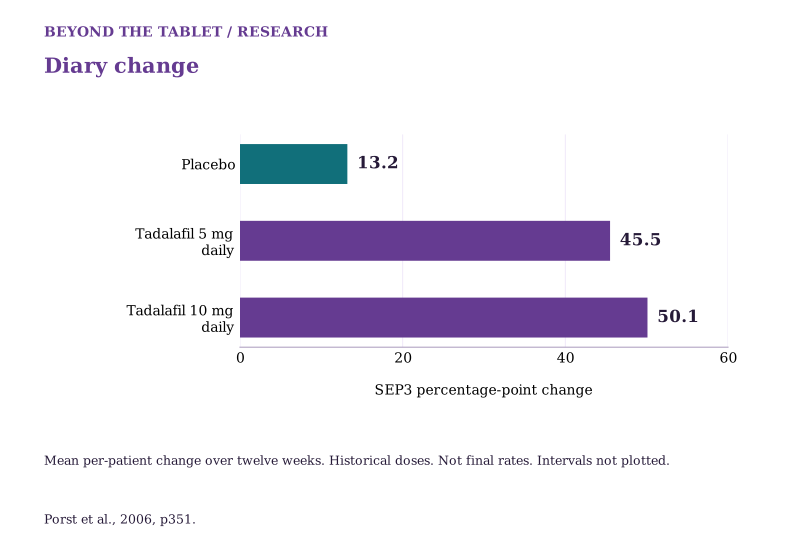
Download chart (PNG)Download data (CSV)Download vector (SVG)
| Group | Change |
|---|---|
| Placebo | 13.2 |
| Tadalafil 5 mg daily | 45.5 |
| Tadalafil 10 mg daily | 50.1 |
Mean per-patient change over twelve weeks.
Historical doses. Not final rates. Intervals not plotted.
Begin with the event behind the diary answer
SEP3 records intercourse success. To understand a diary measure, start with the event that generates an entry, rather than jumping directly to a percentage. An observation must have a definition before it can be counted consistently. In general, changing the definition can change the result even when the underlying experiences are identical. This is why the wording and timing of an assessment matter.
Next distinguish the event from the person reporting it. One individual can contribute several entries, and several entries do not automatically represent several independent people. A reader needs to know how repeated observations were summarized. The question is not whether one unit is inherently superior: it is which unit corresponds to the claim being made and how the analysis handles that unit.
This habit also helps with product descriptions. Our guide to ingredient studies and product evidence asks what an evidence record actually identifies. A diary answer concerns a defined observation; it is not a measurement of every property a product might have. Connecting a reported outcome to a different claim requires an explicit argument and relevant evidence, rather than an appealing change of terminology.
Percentage points retain the original scale
Consider a fictional record that moves from 20% to 50%. Subtraction gives a change of 30 percentage points. Dividing that difference by the starting value gives a relative increase of 150%. The two descriptions use the same invented inputs but different scales. Writing merely “an increase of 30%” would obscure which calculation was intended.
A final percentage is a third quantity. It describes the endpoint level, while a change describes the distance from an earlier level. Neither can always be recovered from the other without the missing value. For example, a rise of ten percentage points could connect 10% with 20% or 70% with 80%. The change is identical, but the starting and ending situations differ.
The table is an original arithmetic illustration. Its purpose is to show why the unit attached to a study number carries substantive meaning. Reading a change as a final level invents a result. Reading it as a relative increase changes the denominator. Before comparing headlines, rewrite each number in a complete sentence identifying its starting point, ending point and scale.
| Quantity | Calculation using invented values | Meaning |
|---|---|---|
| Endpoint level | 50% | The final proportion |
| Percentage-point change | 50 minus 20 = 30 | Difference on the percentage scale |
| Relative increase | 30 divided by 20 = 150% | Difference relative to the starting value |
A person-weighted average differs from an event pool
Here is another fictional example. Person A records two successes in two attempts, or 100%. Person B records two successes in eight attempts, or 25%. Averaging their personal percentages gives 62.5%. Pooling all events instead gives four successes in ten attempts, or 40%. The same invented records yield different summaries because the calculations give different weights to information.
In the first calculation each person contributes one percentage with equal weight. In the pooled calculation a person with more attempts contributes more observations. Neither number is a clerical error. They answer different questions, and a report must explain which operation it uses. This matters particularly when readers assume that every percentage printed beside a medicine name is a simple fraction of all attempts.
The distinction is also separate from counting events. Our analysis of successful-attempt counts develops that neighboring question. Reading the analyses together can improve interpretation, but their figures should not be treated as competing scores. First establish the unit, weighting and period in each report. Only then consider whether a comparison is meaningful and whether the studies actually support the desired inference.
Keep the baseline and follow-up records connected
A change score has two ends. In a fictional pair of records, one person moves from 10% to 40% and another from 60% to 70%. Their changes are 30 and ten percentage points. The average change is twenty points. A reader can verify that calculation because both measurements are visible and each follow-up value remains attached to the same person’s baseline.
If a baseline or follow-up entry is missing, that simple calculation no longer applies to the record without an additional rule. Excluding it, estimating a missing value or defining a different analysis population are substantive choices. They should not be guessed from a summary graph. A technique documented for one outcome should not automatically be assigned to another outcome in the same publication.
For a new product claim, the analogous discipline is to preserve the connection between the product identified in a record and the measurement attributed to it. The Ro Daily Tadalafil document review offers a place to inspect public wording. Its inclusion here invites document checking; it does not establish that an offer, its customers or their follow-up records match those in the research.
Distinguish a zero from an absent opportunity
In an invented diary, zero successes among five attempts is a defined proportion. No attempts at all creates a different mathematical situation: a fraction with zero in the denominator is undefined. A blank entry creates yet another problem because it may not say whether an attempt occurred. Treating all three situations as an observed failure would introduce an assumption.
This distinction explains why a study needs explicit rules for diary completeness and analysis. It does not tell us that any particular missing-data pattern occurred in the trial. The useful appraisal question is which records were eligible for each calculation and how departures from the expected record were handled. If the answer is not available in the material examined, that uncertainty should remain visible.
For readers, the broader lesson is that tidy percentages can depend on untidy recording decisions. A sensitivity analysis can ask whether alternative plausible assumptions would change an interpretation, but a later commentator cannot perform one without appropriate data and a stated method. Inventing missing observations to make a calculation possible would create evidence rather than analyze it. The fictional examples here are deliberately kept outside the study record.
Use the comparator for the question it was designed to answer
A comparison with placebo asks whether an assigned intervention differs from the comparison condition on a specified outcome. It does not automatically answer whether one active regimen outperforms another. Even if two active groups each differ from the same comparator, their difference from one another requires its own estimate, uncertainty and analysis. Ordering bars by height is not a substitute.
Randomization helps make groups comparable in expectation, while blinding can reduce the influence of knowing the assigned treatment. Neither feature makes a study relevant to every future product or eliminates the need to inspect missing observations, measurement choices and uncertainty. These are complementary parts of appraisal. A strong design still answers a particular question about a particular intervention and population.
One practical reading exercise is to draw a line between the two groups involved in the claim and name the outcome on that line. Then ask whether the report actually estimated that contrast. This original reasoning tool is useful when a marketing comparison introduces a different preparation or regimen. It reveals when the proposed line has no corresponding measurement, without asserting that the untested comparison would favor either option.
Treatment duration is different from response timing
An outcome collected across a study period does not by itself describe the time between administration and a particular response. Those quantities have different time origins. To evaluate a timing claim, an investigation would need a defined starting event, a defined response, a measurement procedure and an appropriate comparison. A percentage of successful events cannot silently supply a stopwatch.
Current Cialis labeling describes daily ED doses of 2.5 and 5 mg. The chart’s 10 mg daily arm is historical, not the routine currently approved daily ED regimen. Those numbers identify different contexts; they are not instructions for choosing a dose. Reading a research schedule alongside a current label requires preserving that distinction rather than treating a historical study as an individual treatment plan.
The guide to liquid, sublingual and tablet offers helps organize the separate documentary questions. Our interpretation is to write duration, frequency and response timing in different spaces. If a description supplies only one, leave the others unanswered until relevant documentation is available. This prevents a convenient word such as “daily” from being mistaken for a full account of how a preparation behaves.
Map the preparation without filling gaps by appearance
Our editorial framework distinguishes physical form, route, composition and schedule. These fields can be written separately even when a product description combines them in a single phrase. The point is to identify what is actually documented and which proposed inference depends on a missing field. It is not a method for identifying an unknown medicine by its appearance.
FDA explains that compounded medicines lack its approval and premarket assessment of safety, effectiveness and quality, although they can meet individual medical needs. That status should not be confused with a finding about every specific preparation. A claim about a finished mixture still needs evidence directed at that mixture and the property being claimed.
The terminology guide for form and route and the liquid-label question guide provide complementary reading. The table below is our reasoning framework, not a regulatory test or a clinical determination. Its rows deliberately avoid assuming that a shared ingredient proves a shared route, exposure or outcome. A useful next step is to identify the document needed to resolve the exact gap, then discuss that document with the responsible clinician or pharmacist.
| Field | Question to resolve | Evidence boundary |
|---|---|---|
| Physical form | What exact preparation is identified? | Appearance does not supply complete instructions |
| Administration route | How was the identified intervention administered? | A familiar term does not establish a matching route |
| Claimed outcome | What measurement addresses the proposed benefit? | An ingredient name does not establish finished-product performance |
Preserve the distinction between adverse events and suitability
Reported events included headache and back pain. An adverse-event list answers a different question from a benefit endpoint. It does not by itself show the severity of each event, how burdens were distributed or whether a particular person should use a medicine. Those are reasons to inspect safety information directly instead of treating an efficacy graph as a general safety verdict.
The Cialis label prohibits nitrates and guanylate cyclase stimulators such as riociguat. Cardiovascular status, other medicines, kidney or liver conditions and substantial alcohol use require clinical review. An erection lasting more than four hours requires emergency care. Sudden loss of vision or a sudden reduction or loss of hearing requires stopping the medicine and obtaining prompt care. Chest pain, dizziness or nausea during sex warrants stopping activity and getting immediate medical help.
The Viagra label also warns about nitrate and riociguat use and advises against combining it with other ED therapies. A changed form does not remove the need to review the actual ingredients and instructions. Individual suitability is a clinical judgment using the person’s full situation; it cannot be obtained by selecting the most appealing bar or by borrowing another person’s regimen.
Evaluate the evidence trail behind a new comparison
Lilly ICOS funded the research, with company authors and support. A disclosure identifies relationships relevant to appraisal; it is not proof that a particular estimate is either wrong or beyond criticism. The useful follow-up questions concern study design, access to the analysis, the completeness of reporting and whether a proposed interpretation follows from the actual measurements.
When evaluating an offer, build a short evidence trail: the exact claim, the identified preparation, the cited research and the measurement that addresses the claim. The Ro Daily Rise Gummies document review is linked for that documentary exercise. The link does not establish clinical equivalence, current availability or the outcome of using any product. Each of those would require its own evidence.
Finally, distinguish an unanswered question from an unfavorable answer. If a record does not establish comparative performance, the conclusion is that the comparison remains unresolved. It is not automatically a finding that either preparation performs poorly. This disciplined wording allows meaningful research to remain useful while preventing a gap in product-specific evidence from being disguised as a positive or negative clinical result.
Questions about the evidence
Can a reported change tell me the final percentage?
Only if the required starting value and matching analysis context are also available. The same change can connect different starting and ending levels. Keep the reported unit intact, and do not substitute a convenient baseline from another population or another endpoint merely to obtain a final number.
Why can two calculations from the same diary disagree?
They may weight the information differently. Averaging each person’s percentage gives each person one contribution; pooling every attempt gives more influence to records containing more attempts. The fictional example demonstrates both calculations. A difference between them can reflect the question being asked rather than an arithmetic mistake.
Does an interval around an average describe my likely experience?
Not by itself. A confidence interval describes uncertainty in an estimated quantity under an analysis, while individual outcomes can vary around that quantity. A personal prediction needs additional information and a suitable model. Neither a point estimate nor its interval substitutes for assessment of the actual treatment and medical context.
Can a familiar ingredient settle a question about a new form?
It can identify a reason to investigate, but it cannot complete the comparison. Specify the preparation, administration route and claim, then ask which measurements connect them. Our framework treats that as a research question. It makes no assumption that an altered form is either equivalent or inferior.
What should I retain when summarizing the research for a discussion?
Retain the unit, the comparison, the observation period and the distinction between a final value and a change. Keep any hypothetical arithmetic separate from observed results. Then state the product question that remains unresolved. This gives a clinician or pharmacist a clearer starting point than a detached percentage or a broad request for the strongest option.
Editorial assessment
Our assessment is that a diary result becomes most informative when its construction remains visible. Trace the path from an event to a personal proportion, then to a group summary and a comparison. Each step contributes meaning that can be lost in a short headline. Apply the same care to the preparation: form, route and schedule are separate fields, and a change in one introduces a question requiring relevant evidence. This reading method supports a focused conversation about a particular prescription without converting research arithmetic into personal dosing advice or a claim of product equivalence.
Research access and limitations
Full Porst report reviewed via public exhibit. Labels and FDA guidance checked October 23, 2026. Separate protocols, supplements and individual records were not examined. The worked calculations are invented educational examples. This publication claims neither clinician sign-off nor firsthand treatment experience.
Original sources
Access notes distinguish the research examined from current prescribing and regulatory information.
- Porst et al. (2006): daily tadalafil trialOriginal primary paper · Checked October 23, 2026Full paper (public exhibit)Source-register context →
- Understanding the risks of compounded drugsFDA public information · Checked October 23, 2026Source-register context →
- Cialis (tadalafil) prescribing informationCurrent prescribing information · Checked October 23, 2026Source-register context →
- Goldstein et al. (1998): oral sildenafil trialOriginal primary paper · Checked October 23, 2026Full paper (public exhibit)Source-register context →
- VIAGRA (sildenafil citrate) US prescribing informationCurrent prescribing information · Checked October 23, 2026Source-register context →