A number beside a medicine name can look like a complete answer. Yet a useful interpretation begins one step earlier: what was counted? A successful event, a person reporting improvement and a percentage of attempts describe different things. Confusing them changes the question that the research appears to answer, even when every digit has been copied correctly.
This guide uses a trial figure as a starting point for original statistical reasoning. Every worked example here uses fictional inputs to demonstrate an arithmetic principle; none reproduces patient records. The aim is to connect the meaning of a result to the identity of a preparation, then identify what further evidence would be needed before making a claim about a different form.
Study overview
- Observation
Ask whether the unit is an event, a person or a proportion.
- Time
A counting window belongs with the number, not in an optional footnote.
- Comparison
Specify whether the question concerns an endpoint difference or change from an earlier measurement.
- Product identity
Keep physical form, route and treatment schedule in separate fields.
Trial figure and data
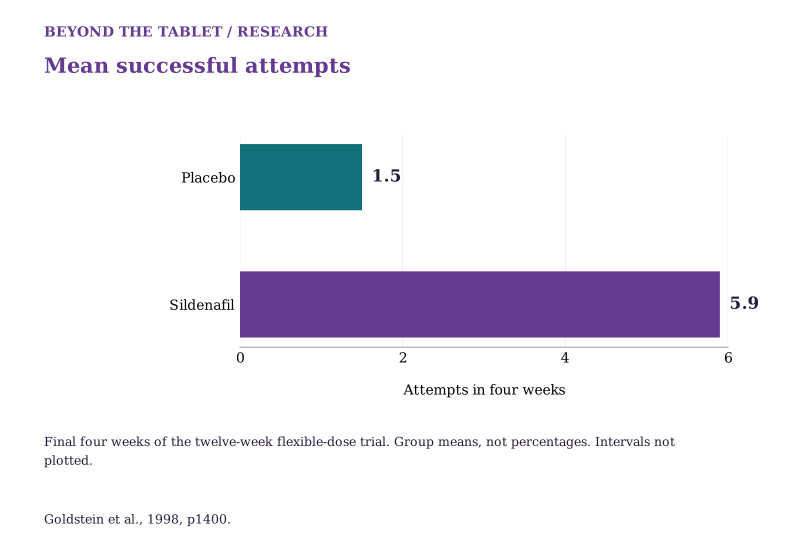
Download chart (PNG)Download data (CSV)Download vector (SVG)
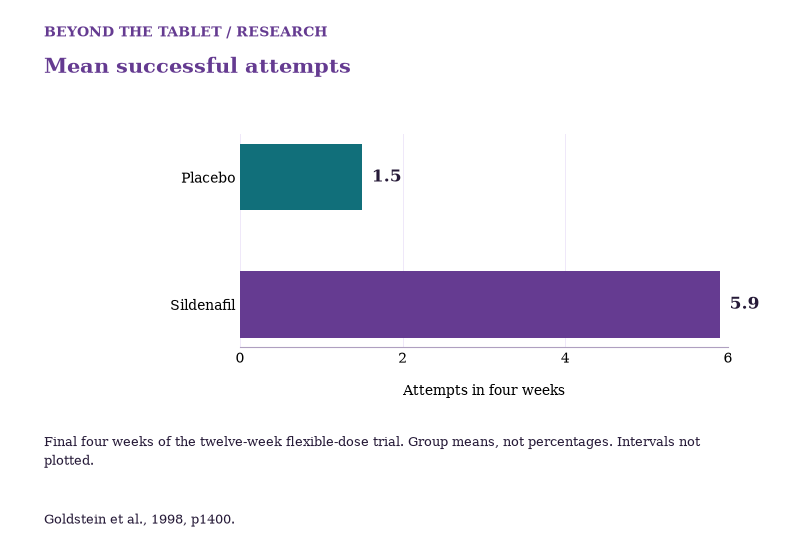
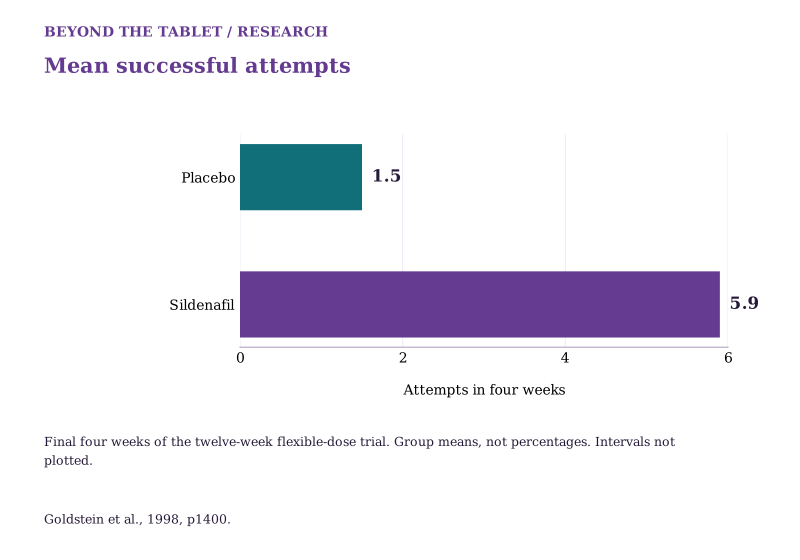
| Group | Mean |
|---|---|
| Placebo | 1.5 |
| Sildenafil | 5.9 |
Final four weeks of the twelve-week flexible-dose trial.
Group means, not percentages. Intervals not plotted.
Define the observation before reading the bars
The flexible-dose comparison randomized 329 men with ED to oral sildenafil or placebo. The chart identifies its observation window and measurement unit. Those labels should travel with the result whenever it is summarized. Removing a unit can quietly turn a count into a probability; removing a time window can make a bounded observation sound like an ongoing expectation.
Here is the reading procedure we use: first name the event, then locate the period during which events were counted, then identify how the individual records became a group summary. Only after those steps should the size of a bar be interpreted. This is an analytical sequence, not an additional finding about the participants. It prevents a familiar ingredient name from doing work that belongs to the methods.
The same discipline applies when moving from research to a commercial description. Our guide to ingredient evidence and the finished product explains the documentary question. A review can help identify a claim requiring evidence; it cannot fill an absent measurement simply because the claim sounds compatible with a trial.
A fractional mean does not describe a fractional event
An average can contain a decimal even when every recorded event is a whole number. Imagine five fictional people with counts of zero, one, two, three and four. The total is ten, and dividing by five produces a mean of two. No special event worth a fraction was needed. The decimal in another average would arise from the division, not from partial success.
Now replace that distribution with zero, zero, zero, zero and ten. The mean remains two. However, the second distribution concentrates every event in one person. These invented examples show why the center of a distribution does not reveal its spread, the proportion recording any event or the experience of a typical individual. The table is arithmetic, not study data.
To distinguish those possibilities in real research, a reader would need information about the distribution or a separately defined responder outcome. An average alone cannot supply either. Asking for that information is more useful than translating a decimal into a promised personal result, and it leaves room for results that vary substantially within a treatment group.
| Illustration | Five individual counts | Mean count |
|---|---|---|
| Distribution A | 0, 1, 2, 3, 4 | 2 |
| Distribution B | 0, 0, 0, 0, 10 | 2 |
| Interpretive question | How are events distributed? | The mean alone does not answer |
Separate successful events from opportunities
A count of successes does not contain the number of opportunities unless that denominator is supplied separately. Consider two fictional records: three successes among four attempts, and six among twelve. The second record contains more successes, while the first has the higher successful-attempt percentage. Neither arithmetic statement contradicts the other. They describe different features of the records.
An evaluation can therefore ask several legitimate questions: how often a person attempted an activity, how often the activity succeeded, and what fraction of attempts succeeded. Selecting one does not make the others irrelevant. It does mean that a summary should keep its original unit. Multiplying or dividing a reported mean by an unrelated enrollment count would not recover the missing attempt denominator.
Our companion discussion of daily-treatment diary percentages examines a different construction. Read the two analyses as exercises in measurement, not as a contest between bar heights. Before placing results together, establish whether they describe counts, proportions or changes, and whether the same people and observation periods contribute to each calculation. Without that alignment, a numerical comparison can be precise but answer an unintended question.
Decide which subtraction answers your question
A final measurement and a change from an earlier measurement are different summaries. In a fictional example, one group rises from two events to four and another from one to two. The endpoint difference is two events. The changes are two and one, so the difference between changes is one. Both calculations are correct; neither should be labeled as the other.
The choice depends on the question and the study analysis. A baseline measurement provides context, but subtracting it is not automatically an adequate adjustment for every imbalance. Conversely, an endpoint contrast is not automatically a description of improvement within each person. A report should identify which quantity it estimated and how baseline information entered the calculation, rather than leaving the reader to infer that from a graph.
For a formulation claim, write the intended question in words before seeking a number. Is the claim about a comparison with an inactive control, a change from earlier function, or a comparison between two preparations? These are separate questions. This editorial exercise does not recalculate the published study; it makes explicit the additional reasoning a new claim would require.
Assignment and observation are separate parts of a trial
Random assignment is a method for making treatment groups comparable in expectation. It does not promise identical people in each group, nor does it guarantee that every assigned person supplies every planned observation. A careful reading follows both paths: how participants entered groups and how their measurements entered the analysis. Keeping those paths separate prevents enrollment from becoming a universal denominator.
Imagine an entirely fictional diary study in which someone is assigned a treatment but never returns a usable log. Counting that person as enrolled is straightforward; deciding how to represent the missing diary requires an explicit analysis rule. Assuming no successes, excluding the record and estimating an unobserved value answer different questions. None should be inserted silently by a later commentator.
This is also why a product-review page serves a different purpose from a trial report. The Hims Sildenafil document review is a place to inspect the published offer and its limits. Linking to it does not connect its customers to a research population or establish that their measurements were collected with the same definitions. The evidence trail needs an actual connection, not merely a shared name.
Keep precision distinct from the size of an estimate
Two group averages can differ without telling the reader how uncertain their difference is. Precision depends on features such as the amount of usable information and the variability of observations. A confidence interval is a way of expressing uncertainty under an analysis model; it is not the range of outcomes promised to individual patients. Those two interpretations require different information.
No interval should be reconstructed from the height of a bar alone. Nor does the absence of an interval in a simplified illustration mean that the original investigators had no analysis of uncertainty. This figure is a selective display. A reader evaluating a statistical claim should return to the relevant estimate, analysis and assumptions in the report, rather than treating visual distance as a statistical test.
Pfizer funded the research; company involvement and investigator consultancy were disclosed. That information belongs in the appraisal, alongside the methods and results. Funding is not a mathematical correction factor, and a disclosure cannot establish whether a particular estimate is biased. It prompts concrete questions about design, analysis and reporting, which require evidence rather than a presumption in either direction.
Give physical form and administration route different fields
Our editorial method uses separate fields for what a preparation is like physically, how it is administered, what it contains and how its use is scheduled. A description may answer one field clearly and leave another unresolved. Treating a familiar word as an answer to every field creates an apparent match that has never actually been documented.
For an invented example, suppose two records share an ingredient name but one gives a physical description without any administration instructions. That missing route is a question to resolve with the appropriate professional record, not an invitation to choose a route from the appearance of the product. The example makes no claim about how any marketed preparation is absorbed or how quickly it acts.
The guide to solution, suspension and sublingual terminology keeps those categories distinct. The accompanying label questions for an ED liquid provide a place to organize documentary uncertainty. Reading the fields side by side is useful because it reveals precisely where a proposed comparison depends on an assumption. It does not establish equivalence, and it is not a method for changing an individual prescription.
Identify the kind of evidence a new claim would need
A clinical outcome claim and a claim about drug exposure concern different measurements. In principle, a formulation comparison might examine a defined outcome, a measured exposure or another specified property. The necessary design depends on the claim. An analysis of one property should not be described as a direct observation of a different property merely because both involve the same ingredient.
Consider an invented claim that a changed preparation produces a faster response. To evaluate it, one would first need a defined response, a starting point for timing, a comparison and an observation procedure. A count accumulated over a period does not itself supply that sequence of measurements. This is a logical distinction between endpoints, not a conclusion that the changed preparation is faster or slower.
The comparison of documented liquid and tablet offers can help frame the product question. Our interpretation is to write down the claimed difference and the measurement that could answer it before looking for supportive numbers. This approach makes a research gap specific: an unanswered timing question remains a timing question, rather than becoming a broad judgment about every aspect of a preparation.
Treat a changed preparation as a defined research question
FDA does not approve compounded medicines or assess their safety, effectiveness and quality before marketing. They may meet individual medical needs. That regulatory distinction does not determine the outcome of every preparation. It does prevent an ingredient study from functioning as automatic approval of a finished mixture.
A useful editorial comparison can list exactly what is shared and what has changed. If the available record does not establish a field, mark it unresolved instead of filling it with a familiar default. The table describes a reasoning framework; it is not a laboratory assessment. Its purpose is to show which additional documents or measurements would bear on a particular claim.
The Hims Sildenafil Chews document review is another route into the record-checking exercise. It is included for its documentary context, without a claim that an offer matches the trial intervention. A persuasive comparison would connect the identified preparations to the evidence for the proposed conclusion. Brand recognition, a shared ingredient or the attractiveness of a format cannot supply that missing connection on their own.
| Field to establish | Evidence question | Unsupported shortcut |
|---|---|---|
| Exact preparation | What defined product was examined? | Treating an ingredient name as a complete identity |
| Administration | What route and schedule were evaluated? | Inferring instructions from appearance |
| Claimed advantage | What outcome would demonstrate the difference? | Using an unrelated endpoint as proof |
Read harms with the same care as benefits
Headache, flushing and dyspepsia were reported. A benefit count and an adverse-effect record should be interpreted separately: having more of a desired event does not mean that unwanted events disappear. Equally, listing a symptom does not describe its frequency, severity or effect on every participant. Those are additional questions for a safety analysis.
The current Viagra label prohibits use with nitrates or nitrites and with guanylate cyclase stimulators such as riociguat. Cardiovascular suitability, other medicines, and kidney or liver conditions require clinical assessment. An erection lasting over four hours requires immediate medical help. If vision is suddenly lost, or hearing suddenly decreases or is lost, stop taking the medicine and obtain prompt medical care. Stop sexual activity and get medical help if chest pain, nausea or dizziness occurs during it.
These are current safety instructions, not deductions from the chart. The Cialis label likewise warns against nitrates and riociguat and does not establish the safety of combining ED therapies. An individual decision therefore needs a clinician who can assess the actual prescription and medical context. A research article can clarify the evidence; it cannot perform that assessment through a numerical average.
Questions about the evidence
Can I turn a group mean into the number I should expect?
No. A mean summarizes a group, and many different distributions can produce it. Predicting an individual experience would require additional information about variation, relevant characteristics and the actual treatment context. The fictional distributions above demonstrate the arithmetic gap without claiming to model the participants or to provide a personal forecast.
Does a larger count always mean a larger success percentage?
No. The denominator matters. Someone can record more successful events while also making many more attempts. A count and a successful-attempt percentage can therefore move in different directions. To interpret either, keep the event definition and observation period attached and ask what information the chosen summary leaves out.
Would a trial with more participants settle a formulation question?
A larger sample may improve precision for the question actually studied, but sample size cannot change the identity of the intervention or endpoint. Before asking how much evidence exists, ask whether it addresses the proposed comparison. A precise answer to an ingredient question is not automatically an answer about a changed preparation.
Why keep fictional examples separate from research figures?
An invented example lets the reader inspect an arithmetic principle because every input is visible. A study estimate comes from observations and an analysis that must be examined on their own terms. Mixing the two could imply access to patient records that the publication does not possess. They serve complementary, clearly separated purposes.
What makes a useful question for a clinician or pharmacist?
Name the unresolved field and the claim it affects. For example, ask which document identifies the prescribed preparation and whether the cited evidence concerns that exact form and route. This is more actionable than asking whether an ingredient is generally good. It keeps the discussion connected to a specific medicine and a specific decision.
Editorial assessment
Our editorial assessment is that the most useful reading skill is preserving the measurement as it moves between contexts. Keep the event, period, summary and comparator together. Then inspect whether the product description identifies the same intervention or introduces a new question. This sequence allows a study to contribute real evidence without assigning it claims it never investigated. It also makes uncertainty practical: instead of accepting or rejecting a preparation on a headline number, a reader can identify the missing record or measurement and bring that precise question to a qualified professional.
Research access and limitations
The full Goldstein report was read from a public exhibit. Labels and FDA guidance were checked October 23, 2026. No separate protocols, supplements or individual records were examined. Illustrative calculations are original editorial examples. No clinician review or firsthand treatment testing is claimed.
Original sources
Access notes distinguish the research examined from current prescribing and regulatory information.
- Goldstein et al. (1998): oral sildenafil trialOriginal primary paper · Checked October 23, 2026Full paper (public exhibit)Source-register context →
- Understanding the risks of compounded drugsFDA public information · Checked October 23, 2026Source-register context →
- VIAGRA (sildenafil citrate) US prescribing informationCurrent prescribing information · Checked October 23, 2026Source-register context →
- Cialis (tadalafil) prescribing informationCurrent prescribing information · Checked October 23, 2026Source-register context →
- Porst et al. (2006): daily tadalafil trialOriginal primary paper · Checked October 23, 2026Full paper (public exhibit)Source-register context →